Friday, September 12, 2014

Bhaktapur and Paradise in Pokhara

Good news everyone! Tomorrow we will set out on a trek near the Annapurna Mountian Range. The trek is called Poon Hill and it's super popular among backpackers. Our itinerary is as follows:

Friday: fly to Pokhara
Saturday through Wedensday: trekking from Mayapul, Ulerig, Ghorepani/Poon Hill, Shinadanda, then back to Mayapul and Pokhara
Thursday through Sunday: sightseeing etc. in Pokhara and Chitwan National Park
Monday: Take a bus back to Kathmandu
Tuesday (the 22nd): off to Hanoi

We are really excited and relieved the rest of the trip was planned for us by our trusty hotel owner and his trekking experience and connections. Our wallets took a beating, but that's why we're on vacation! When we get back Seth wants to go see the Himalayas in a plane! We'll see how the weather is, and how our wallets are feeling then.

So now, the past few days in a nutshell:
To recap Thursday, we went to Bhaktapur. Similar to the day trip we took to Patan, Bhaktapur is another ancient city which we're super glad we saw, even though there's a lot of tourist-specific pricing. The buildings and temples were impressive and beautiful. They are medieval in origin, and Bhaktapur acted as the captial/central hub of Nepal from the 8th to the 15th century. Our cab driver, who we met taking us to Patan, drove us to Bhaktapur and gave us some tips on the city. He explained that since the Nepalese government is fairly corrupt (and what government isn't nowadays?), it jacks up the prices for tourist spots all over the country. So, like before at Pashupati, it cost a certain amount per head to get in. Our driver, Assok, told us how to get around these rules and get into the city, undetected, which was super cool of him, since we were trying NOT to bleed money.

Patrice in front of a super old temple
We wandered down an alley or 10 before we got too lost. We came up to an alley that put us right next to the entry gate: much too close to not be seen. So, we sighed, and turned around to start walking the way we came, and then heard a "psst." We turned around and one of the elders sitting on platform motioned for us to go just around the corner. The 5-year-old nearby old confirmed his instructions with a nod of his head. The people of Bhaktapur had come to our aid!!

So, we made it in, no problem, and then walked through the city, meandering and taking pictures of all the cool old buildings and streets. Unfortunately, we turned down the wrong street for some street samosas and missed the gate (those samosas were like a damn delicious Nepali poison apple). A guy stopped us and said we needed a ticket, so we said, "ok, we'll just leave." We then walked the perimeter of the city trying to find our new way in, but eventually found our way back to Assok at the taxi spot. We were pretty defeated and were ready to go back to Kathmandu. Assok could see that we needed a morale boost from getting caught, so he suggested going south to see the pottery market. So, we did.


Scenes from Bhaktapur
Even more cautious than before, we snuck through even more alleys to find it. I guess the potters hadn't set everything up yet, but there was an old man making clay bowls on his spinning wheel. It took him about 30 seconds to make one and then start the other. An efficiency unequalled. We walked another 50 feet up the hill to Taumadhi square. Like nervous little squirrels, we peeked around the corner expecting a gaurd, but...there was no one there. But there were the most impressive temples I'd seen thus far. I forgot to mention, the whole morning the sky was overcast, but by the time we got to Taumadhi square, things started to clear up. We could see some of the mountains that cup the valley and had an even better view from the top of the largest temple:

(Patrice provided for scale)
We walked to the cafe next door and ordered lunch: our beloved masala tea, and aloo paratha (like a quesadilla with curds) and the other was paratha (fried naan/bread) with a curry soup. Of course, it was the best food ever. So, with our bellies full, the sun shine doing its thing, the incredible sights and ambiance to keep our zen thing groovin', we quickly got the morale boost we needed. 

We then hopped back in the cab with Assok and drove back to Kathmandu. While there, we found out that one of the guys who always says hi to us in the morning was the owner of the hostel. Not only that, but he also had a trekking business. So, we stepped into his office and set everything up in about an hour. Awesome! The remainder of the evening was spent with our new friend, Saurav, who took us out to try some momos (like really good dumplings) and tongba. Tongba is a lot like Argentinian mate (a tea), where there are ground up leaves and you put hot water in them and then drink the liquid out of a straw that has a filter on the bottom. Except tongba has millet, and it's alcohol! It was delicious, tasted a little like Japanese sake, and would have been even better if it had been cold outside. Anyway, Saurav is the cousin of my Aunt Patti's friend and colleague. He's a really cool dude, and we like him, so you can too! He too, as it turns out, runs a travel agency, so if anybody interested in going anywhere, we know a guy. The name of his company is Caligo. He's on facebook.
.
Drinking Tungba!

So that takes us to today. We got up this morning and left about half our possessions in the care of Trekker's Home, the amazing hostel to which we shall return when we spend our last night in Kathmandu. This way our bags only weigh about 16 pounds, as opposed to the 35 we had before. Anyway, this morning we took a plane to Pokhara -- oh I'm sorry, did I say we "took a plane"? I meant we climbed into a tin can with a bunch of Koreans out of a really sketchy domestic airport. Actually it wasn't that bad. The plane was 3 seats across and had a really nice flight attendant who happily gave us a caramel, peanuts and fanta! Also, and this is very important for people who have known Seth for a long time: the name of the airline was Yeti Airlines. No joke. The yeti is supposed to have been "seen" or "tracked" in Nepal so I guess a smart person decided to capitalize, and what a great decision. I also wanted to share that the first woman of three patting me down at the airport -- there was no metal detector -- found my bag and said, "This no. What is this." I said, "it's an ostomy bag." "Money bag? No." She indicated I would have to take it off. "No." I said. "POOP BAG." Confused, and possibly a little terrified, she waved me through.

The views of Nepal from the plane were breathtaking. I mean wow. The lush, green mountains all peaked right into the clouds. Some of the water was extra blue. Sometimes we were flying just above the elevation of the mountain peaks. 


Pictures obviously do no justice.
The hotel is $35/night and it's the biggest, fanciest one we've seen on our entire trip. We have a guide who picked us up from the airport and took us here. His name is Reywati. HE IS A SHERPA. Look, the only thing I think of when I think of Sherpas is Owen Wilson's character on Zoolander who is walking through his reallly awesome house and introduces Zoolander (Ben Stiller) and their friend to his Sherpa buddies, wrapped up in really warm clothes and chilling together. So to meet a real Sherpa and know we're going to be hanging out with him for the next 5 or 6 days and he's going to be telling us about all the effing amazing things we're seeing, well that just makes me really stoked. In fact, as I write this I am sitting on the balcony at our hotel and I can see an amazing screensaver-worthy mountain poking up behind the green one in front of me.

EDIT: Reywati is a Brahman, which is the highest Hindu caste. It sounds cooler to have a Sherpa, but is more realistic to have a highly-educated person who can speak English. Oh well, we really like him so he can be whatever the hell he wants.

Don't mind the awkward infrastructure, it's actually really nice here.

 I saw Reywati walking up to the hotel. I pointed out the mountain and he told me the name: Fish Tail, and that it's 6,000 meters high. He knows all the elevations we'll be walking to (up to 3,210 meters) and apparently all the names, too. He's been to Everest Base Camp, up to 5,000 meters (of course he knows the exact number but I definitely don't remember) and he doesn't need oxygen at that elevation because, and I want to be very clear here: he is a Sherpa. His English is great. We took him out to lunch and then he showed us around a temple on an island on Fewa Lake, where a monk put rice with the red powder on our heads again.


 Fewa lake, by the way, is also gorgeous. We have gone from beautiful, polluted chaos in Kathmandu directly to paradise in Pokhara. In fact, if the name "Paradise in Pokhara" isn't the title of something, then nobody has been paying attention.

Well, we're off tomorrow! Not sure how much wifi we'll be getting on Poon Hill but Seth and I will be sure to keep a record of what we do. 

Wednesday, September 10, 2014

Temples, Stupas, and Hinduism 101

Hey gang, Seth here. I'll be recounting our exploits for day two so Patrice and nurse those typing blisters (she doesn't really have blisters...I'm...I just wanted to be funny. Please like me...)
So, after one heck of a start, we took a much more zen-like approach to Nepal and put the high-octane, let's-get-destroied-by-a-mob level adventuring on the backburnner. We transformed and rolled out of the hostel around 9am with a burning purpose: find the fabled Swayambhu Temple (a.k,a. the "monkey temple.") We asked our intrepid hosts of Trekkers' Home hostel, "what's the direction we should head in?" and, ever stalwart, they told us to head south...ish.

We were determined to hoof it, because the map said it was close enough, and we did just that. We do have a reputation to uphold now. Our trek was, like it's predecessors, "memorable." We found a path less traveled by non-locals, over a river, ponds of mud and a construction site that wasn't totally unlike a war zone. Patrice broke in her new sandels reeeeaaaal quick; however, after about half-hour of finding routes through peoples' yards and driveways, we made it to the steps of Swayambut.
Like any place a tourist might visit, the steps were crawling with beggars and touters. We are no strangers to these sorts of things, so we, unphased, marched on. We mad a pit stop after the first 50 steps or so for some fresh watermelon and bottled water. Nepal's climate isn't exactly what I had envisioned it to be. Instead of cool and perpetually breezy, it's hot and muggy AND I DON'T LIKE IT!! Anyhoo, the gentleman selling the fruit and water kindly warned us about the monkeys that would, understandably, attempt to rip the tastey fruit from our unsuspecting hands. No sooner had he said that, we heard a rustle in the tree above. At least 6 hairy little imps were staring holes through our watermelon. I told Patrice, "eat quick," but just then, the fruit-man whipped out his trusty slingshot and fended off our evolutionary cousins, lickity split. Hilarious!
So, after properly hydrating and Patrice having had her fruit fix, we climbed the rest of the stairs. We didn't count, but we could make a conservative estimate of 200+ (rather steep) stairs in total, but that's what it takes to see the entire Kathmandu valley. The view, for a lack of a truely better word, was stunning: mountains that put my beloved Appalachians to shame form a momumental bowl to cup the lush, green, and very urban valley. Clouds rolled across the sky like waves on the ocean and a moderate breeze kept the uncoutable prayer flags aloft and the humidity to tolerable levels. Swayambut is a "stupa," a style of shrine that Patrice will explain in Day 3, which stood an additional 40-45 feet tall and was adorned with the ever-vigiliant eyes of Buddha. We shopped for nick-nacks around the stupa and had a lunch equally as pleasing as the view on one of the local cafe's rooftops. Picture provided.
We finished lunch and headed back down the stairs (in hindsight, I guess we forgot to count them twice...) bought a small "singing bowl", which is a meditation bowl made of 7 silvers. You rub the edge of the bowl with a wooden pestle and makes a pretty tone. Then we caught a cab back to our hostel in Thamel, the touristy area. There, we regrouped, dropped off our treasures, and decided on Pashputi (another local temple) as our next destination. Unfortunately, nothing we looked at about Pashputi said, "NO FER-NERS ALLOWED" so, our very non-Hidu selfs were denied access and ushered over to the kid's table equivalent of the compound. We could check that part out, no pro-blamo, ...for $10 a head. Yeah, I don't think so. Only slightly perturbed, we walked to the other side of the road as Pashputi, to see what, if anything, was worth looking at. We found another, small temple with immaculate woodwork and got a small bag of samosas and fried dough for 50 cents. We walked, and munched, and realized, "there's nothing here for us to tour...", so, we turned around and walked back to the street. One last beggar met our eye, so I gave him what was left of our snack. I told Patrice that I felt a little bad for giving the guy our half-eaten bag of food, to which she replied, "yeah, well 'beggars can't be choosers!'" OOOOOHHHHHH, SNAP!!
Well, I thought it was funny...
We quickly found a cab back to the hostel and decided to explore the immediate area (i.e.- J.P. Road). The road is basically a backpackers candyland. I kinda felt like Charlie when he found the golden ticket. We got some shopping done and got to sit for a quick drink in a beautiful courtyard down a little alley to finish off the day. We both were in agreement that we had a much more enjoyable experience since we set our own culturally-driven pace as opposed to the afore-mentioned "high octane" one. I think we found our status quo.
I'm Patrice and I'm back! Isn't my fiance entertaining? Well anyway. The next day we headed off in a cab to Patan, a little city a half hour south of Kathmandu with some pretty great stuff. As soon as we got to the Golden Temple (one of those cool things), a short, friendly Nepali gentleman greeted us, who said he worked at the temple. We paid 50 cents to get in, so we figured he was just a tour guide. In the end we were wrong (again) but he accepted $10 graciously from us, instead of cheating us out of $60 worth of groceries, phew! He was really, really Hindu: a vegan who never smokes or drinks, and is just one of the at peace people I've ever met. He explained many things, but most notably the circle of life in the Hindu faith (I included a picture from google because apparently I forgot to take one): Divided into six parts, heaven is the pinnacle of existance; very good people go here, and become gods. At the bottom is the Hindu hell, which is pretty similar to the Christian idea of Hell: fire, brimstone, eternal suffering, etc. On either side are two additional sections: one one side right below god is the level of "demi-god," where humans go if they are exceptional in the previous life, but not so great that they are godly. The demi-gods and the gods argue over a fruit-bearing tree that connects their sections of the wheel. The gods claim that the fruit is reserved for them, but the tree grows out of the section of the demi-gods so they feel they have a right to the fruit. Anyway, the section below the demigods is the section of animal life: if you aren't kind to animals (like if you're a butcher), you go here. There are about 80 different levels of animal, monkey being the first and dog being the last because dogs are so compatible with humans and loving. After you finish the life as a dog, you go back to being human and are eligible for the demi-god or god level, depending on your accumulated karma as a human. If you're a bad human again (you get two chances), you will go to the level below the humans on the wheel: hungry ghost. This level sucks. It's kind of like purgatory. You have to spend a lifetime in perpetual thirst and hunger as punishment for the bad karma you accumulated in your previous life. If you eat or drink anything, you die immediately, which means you probably didn't have enough time to make up for the bad karma, so you go to the bottom of the wheel of life (i.e. Hindu Hell). In the middle is a depiction of hen, a snake and a pig, symbolizing lust, ignorance and laziness respectively. The goal is to eliminate these vices. Buddha has none of them, which makes him the head hancho (Hinduism treats Buddha as one of the Gods).
Our new friend also showed us his physical-chakra therapy practice using the singing bowls, and demonstrated to us how they (allegedly) help with ailments. Basically, the shape and craftmanship of the bowl give it particular vibrating properties, which massage the body. He demonstrated this by filling one of the large meditation bowls with water and ran a mallet around the rim to make it "sing." The sound waves bounced through the bowl and made the water jump like little fireworks. He explained that since the human body is predominantly water, the bowl's vibrations create a similar effect with your body tissue when you hold the bowl up to the body and vibrate it, enabling the body to relax, thus opening your chakra. We're not sure how much of it we buy into, but when our friend demonstrated this on us, we did feel good and relaxed, and also really in-the-moment, similar to how you would feel if someone gave you a quality back rub. He then explained the seven chakras: you have a crown-of-the-head chakra, for your brain and thoughts; your third eye chakra for healthy eyes, ears, nose and mouth; your throat chakra, for a healthy voice; your heart chakra, for a healthy heart and lungs; a chakra below that for kidneys and spine; a chakra for your intestines; and a chakra for your lower extremities. He also explained that the right side of your body is the male energy, and the left side is the feminine energy. Thus according to legend, Buddha was born not of  traditional delivery, but rather was born through the left armpit of his mother. Yes. I said armpit. Not kidding. But when you think about it, this is all not wholly dissimilar to Christ's virgin birth.
The last thing our friend taught us was about prayer wheels. They're everywhere here around temples and stupas, and basically you are supposed to walk clockwise around the structure in question and spin them as a form of meditation. They're pictured below in a few different places. We've circled several temples and stupas now, making a point to spin all the prayer wheels. And I can confidently say we at least partially get it. There's something extremely peaceful about just walking and spinning one prayer wheel after another, after another, after another. I'm sure we've just dipped our toes into the ocean that is Hinduism and Buddhism but Seth and I have both just really enjoyed zenning out with it. There's a meditation song that's always played (and sold on CDs) around these temples, and I found it on  youtube! So here it is:
http://m.youtube.com/watch?v=gx1SrxDwxXo
The words are "Om Mani Padme Hum" (just like the title, duh) and bring it all back in a ... CIRCLE... (eh? Eh???) those are the names of the different stages of life on the circle of life.
Finally, after seeing some more temples in Patan and drinking some more masala tea (we are officially hooked on chai), we headed over to the Boudha stupa. A stupa is like a burial mound for the creamated remains of significant individuals, and you can usually find one in front of every Hindu temple. The more sacred you are, the bigger your stupa. The Boudha stupa supposedly contains some of the ashes of the Buddha himself, so you can imagine how enourmous it is. According to the pamphlet, whoever walks around it (which takes about 6 minutes, as long as you don't stop to buy anything, which is hard) enough times, or does enough nice things for the stupa, will get what they want in the next life or just get their wishes granted. Just a preview of a very big paragraph: "All of those who circumambulate it will acquire the seven qualities of the higher existences. Whoever makes entreaties to it will effortlessly accomplish the two purposes. All of those who make offerings to it will be born in a place that knows no drought. Whoever offers flowers will be sure to obtain an excellent human birth with al of the conditions required for the practice of Dharma." Etc. etc. etc. It goes on and on.
So that brings us to now, Wednesday morning. A few cultural observations before I... PEACE OUT. Oh man I have to stop.
- They turn off the electricity twice per day, city-wide here, for about 2-3 hours. These hours seem to rotate (every day each one starts about an hour earlier), but luckily they don't turn off the wifi in the hostel. Everybody seems to have a back-up gas-powered generator for the necessary stuff during those times.
- On a related note, our hostel has one functioning outlet, and Seth and both use our devices a lot for reading, taking pictures, writing the blog, etc. So we are constantly charging something, when there is electricity anyway.
- Our hostel room is old. The ceilings are high, the wallsare eggshell blue, we have a wooden wardrobe and an enormous window overlooking the street of Thamel, and the window isn't very sound-proof, so we always hear something like honking or pigeons or rain. There's a fan on the wall, and a non-functioning outlet below it, but the fan chord doesn't seem to be able to reach the non-functioning outlet. I don't get it. We also have a huge skeleton key for getting in and out. Honestly, I love it. Ants and all.
- Someone tried to sell Seth drugs! Actually three people. Within about thirty minutes That's pretty common in this area. There was a cop right there. Seth told them to get the hell away from him.
- Just like your favorite yoga teacher, everyone, EVERYONE here greets each other with "namaste" and then says it when you leave too, like a "peace be with you" kinda thing.
The Bouhda Stupa
A Hindu monastery
Prayer wheels
Swayambut,  or monkey temple
Lunch on top of Kathmandu: goat cheese and tomato salad, curry, chai tea. Amazing.
tside a temple
More prayer wheels
Chakra therapy
Prayer flags and people at Swayambut
Swayambut

Monday, September 8, 2014

From Osaka to Chaos: Welcome to the Third World

We weren't in Osaka for very long, but as per our new usual, we still walked and walked until we couldn't walk anymore, then walked a little more. We eventually found Osaka castle, which was definitely the most impressive castle we saw in Japan. It was well-preserved and the walls next to the moat were just monstruous. We learned later, that wasn't even the outer moat! It was inside the first, which had been filled in many years ago. The story of the castle was even more interesting though. Hideyoshi Toyotomi is Japan's biggest rags-to-riches story. He was born a poor farmer's son, then eventually rose through the ranks (and bloody battles) to become the unifier of the nation and built the castle. He actually was the first to lead the invasion into Korea in the 16th century, which resulted in a massive Korean genocide that rocked the populace. He wanted the territory, and he wanted the people of other surrounding countries to respect him and pay homage to him. He had won enough battles at that point though, so in order to occupy himself while everybody was off in Korea fighting, he stayed at home rehearsing a play. I came to the conclusion at the end of our castle-museum tour that this guy had some little man issues. Once he finally had a son by his concubine for example, he had the rest of his family killed, including his wife of many years and their daughters, in order to secure his son's position as the next ruler. Oh yeah. And when he died, he wanted to be enshrined as a god. His son lost a battle fighting to keep his position, and then commited suicide, effectively ending the family line. Oops.

The castle was cool, and Osaka seemed like it would be a pretty cool place to hang out, but it was not foreigner-friendly like Tokyo and we had a hell of a time trying to figure out our way around. What it did have, however, was Brian Richards! We found Brian at his hotel ten minutes after he got there, and all went out to dinner. We  drank sake, ate okonomiyaki one last time, this time with potatoes, bacon, cheese and seafood, and also takoyaki. Takoyaki is otherwise known as octopus balls, which means someone just takes a small piece of octopus and undercooks some dough around it. Not the most exciting form of octopus, but I was glad to try it. Afterward we looked around for a bar and found a sign for one that offered drinks for under $9 called "Continue." The font looked like it was from a video game. Lo and behold, upon entering, we realized we had just gone into a video game bar. At the bar itself, you had various consoles set up for the patrons to actually play while drinking! Most of them were Nintendo and Sega. At the far corner, a group was playing "Street Fighter." The walls and the rafters were adorned with everything video-gamey, like toys, controllers, game cartriges, memorbilia, and there was even a corner where board games were available. The entire bar was devoted to gaming and drinking. Brian and Seth were in geek heaven. That bar is perfect for them, and anyone else who happens to be in Osaka and likes to drink anything that's not wine (unfortunately) while playing any game you could ever want, unless it's capture the flag. Or a sport. Darn it you know what I mean.

I wouldn't write about the transit, but something really weird happened after we finished stuffing our faces to kill time at the Benningtons in Incheon Airport. We were on our way to the check-in counter and ran into two people we had only met for a week in Gwangju and hadn't seen in two years, i.e. our predecessors from the school. I saw them and said, "WHAT." And then one of them said, "WHAT." And then we all just kept saying "WHAT." And then we just caught up for about twenty minutes. It was so serendipitous. They were the first people we ever really talked to in Korea because they showed us around the school and helped us figure out what we were going to be doing -- basically we were the new them when we came, just like our replacements are the new us now. And then, they were the last people we would ever talk to before leaving the country. We really came full circle on that one. I think it was the perfect way to leave Korea!

So. We flew into Kathmandu. Wow, Kathmandu. Where do I start. Ok. First impressions:
We had to get a visa on arrival in the open-air airport, and of course hung out in a really long line forEVER behind some Koreans and a group of about 20 college sophomores from the US who were getting 90-day visas, probably to hike Mount Everest or something. The process of getting a visa isn't too bad, and maybe takes a total of about 4 minutes per person, but this big group of kids took a long-ass time and meanwhile exchanged stories about their CRAZY dreams and like, really CRAZY things that happened to them. It wouldn't have bothered me if I wasn't so sleep-deprived I'm sure (it was about 2AM Japan time), but there were only 4 customs agents working in their 19th century wooden booths and we just wanted to go to the hostel. Of course the pre-arranged cab to take us to the hostel didn't show up, so a 23-year-old promoting his travel agency gave us the same price as we would have paid anyway and put us in his unmarked yaris with his "uncle" and himself. He said "I will talk to the reception to make sure you don't have to pay for the cab you arranged in advance." I didn't have any cash and he said the hotel would pay him anyway. We got to the hotel, and he talked to the guy at reception. This guy. This guy opened his book, and the only thing on the page FOR THE DAY was: "Patrice Thompson - 2 people. Airport pickup 10PM." And you could see the "whoopsies"on his face before he told our new travel agent friend that we WOULD have to pay for the service that was never rendered, presumably so his boss wouldn't notice he messed up. I argued with him and it didn't take long for him to change his mind. He paid the travel agent with his own money.

We woke up to the sounds of the JP Road in Thamel. To set the stage, all the movies of India you see where there are cars and rickshaws navigating through bumpy, unpaved roads around people (or people navigating around them) with the sounds of honking and bells ringing from temples, and incense burning, and people haggling, and people in beautiful colorful clothing, and really old buildings and temples everywhere? That's an accurate depiction of where we are right now. I haven't seen one 7-11, or a McDonalds, or really much of familiar things at all. We are really out of our comfort zone (which is a goal of traveling, of course). As soon as we walked outside around 9:45 to start exploring, we were bombarded with people trying to sell us things: "hey, where are you going? Can we take you there? Very cheap. Do you want to buy this necklace? Very cheap. Are you going trekking? Come to my travel agency. I give you good price." We finally kind of shed ourselves of them and were on our way to Durbar Square when a 22-year-old came up and complimented Seth on his hat. Seth said he had a nice hat too. They started talking and the guy, Sunny, who wasn't trying to sell us anything apparently, had us follow him into an alley where he did not sell our organs, but instead showed us a temple in a little clearing. We left the clearing and some men in colorful robes approached us and happily put some red color on our foreheads for good luck, and flower petals on our heads for happiness. "Wow, thank you!" We said, thinking, what a cool service. "Five of your dollars and your god will be very happy," they said smiling. Oh. We started looking for money when some other men passing by said, "Don't give them money! It's bad karma. God will be angry. You should give them food." Their faces dropped. Sunny confirmed this, saying we could do what we wanted but with money we would make God angry. So they went to a little shop and picked out some cookie packages, the price of wich came to $1.42, which we paid. Sunny explained, if you give them money, they might not spend it wisely on themselves like with smoking and drinking, but everybody needs food, and it goes into the body, so God is happy.

Sunny taught us many things in the hour and a half we found ourselves following him around, like how to say "thank you," and the steps to worship at a Hindu temple. You take a candle, and move it in three circles in front of you clockwise: once for a good life, once for a long life, and once for a happy life. Walk around the temple clockwise and ring the bells you see as you go, then put the red color on forehead of the god statue for good karma, some flower petals on the top of your head for happiness, and some red powder on your own forehead for good luck. He showed us some really, really old temples, like 1600 years old. One of them had a statue of Mary, Jesus' mother. She was much sexier and golder than the Mary we all know, but Sunny said she's a god too. Around this time, I asked Seth, "what does he WANT??" Quietly, Seth said, "he's just a nice guy." Maybe he heard us because a minute later he assured me that he didn't want money; he just wanted rice and milk for his 3-year-old sister. He showed us a few more things, like a famous tree they put a lot of color on during the Holi festival, and then he took us to store where he got some groceries. Whatever you want, Sunny, we said, we really appreciate you showing us around. Another time we saw a businessman sticking pasty, doughy sugar cookies onto a huge, colorful wooden head. Sunny said, "if you give that god food, you will have a good life. If you give him sweets, you will have a sweet life." The businessman wanted a really sweet life I guess, because he just kept forcefeeding the head cookies! Then I did it too. Why not. A lot of the things yesterday were done with a "why not" attitude.

Now, I can see the skepticism on your face, like, "this is really dumb. He's going to swindle you," which is exactly what was going through MY head yesterday. But how much could groceries cost?? Well, you're right. He wanted $120 worth of groceries. $120. What?!?! Ok, touche, Kathmandu. We took stuff out and got a smaller bag of rice, and got the cost down to $60. Still, it's dumb, and not worth a two hour tour, but man did he get us. Such is the way of life. The smart outsmart the people who have been in Kathmandu for 12 hours. The weirdest part? The guys running the shop started making casual conversation with us in the middle of this ordeal. We're standing there, having just been blindsided by this super friendly guy, trying to cut costs, and the shopkeepers start asking us, "oh yeah? Where in the USA are you from?" I guess this is probably not an uncommon thing.

We went back to the hotel and licked our wounds with some extremely affordable mutton curry and samosas in the safety of the hotel on site. And, being a little jetlagged, we took a nap. But Monday was a huge festival day in Kathmandu, one of the biggest festivals of the year called Indra Jatra in Durbar Square, which is a square with about 400 temples within walking distance of our hostel. So of course we had to go. We walked outside confidently, this time not being so nice to people who started talking to us, and headed to the square. We waited with a crowd for about an hour and a half, just having no idea what was going on. We were all packed really close together and it rained a bit. We weren't really sure what we were looking at, but one guy with a motorcycle helmet seemed to get a little too close to my derrier, and Seth was a few people behind so he couldn't see so I did my best to ward him off. Eventually we walked with the crowd into the square and the police said we all had to get closer together because an enormous effigy was about to go through. They phyically pushed us all together, against a building. I saw the headlines: "Two Americans were crushed today..." I made eye contact with one of the voluteers helping the push effort, and mouthed "no way" and I guess he took pity on me and Seth because he pulled us out of the crowd. Right about that time, motorcycle helmet took the opportunity of everybody being packed in to give my left boob a squeeze, so on the way out I dropped my elbow into his back, HARD. I hope it hurt. Seth found out later he was also violated in another way in that crowd, as in someone pickpocketed him, although he didn't lose more than $2 or $3.

I know what you're thinking. "Ok, so then you went home." Nope. Not us. We hung out where the volunteer put us for a few minutes (and told us to watch our bags), and then he said the Kumari, the 13-year-old child godess for whom the festival was taking place, would make an appearance around 7:30 (we'd been waiting since 3:30 and it was now 5:30). To give you an idea of where we were, the Nepali royal family was watching from a porch, along with many other foreign diplomats. There was a band playing, what seemed like a group of Nepali marines standing in uniform, police in riot gear, and people. People everywhere. Sitting on the sides of the temple, all the way up to the top. Pouring out of every corner and entrance possible. There was even a monkey on the roof of a building. But the volunteer changed his mind about where he wanted us. So he pulled me and Seth in front of a military procession, and at least five police and guards tried to stop us until they saw we were with him. In front of everybody, with the Nepali royal family looking on and all the people, we were taken to a different group of photographers and tourists, where we stood for about twenty minutes while people took pictures of Saudi diplomats and  other important people getting into their cars, ten feet away. By 6PM our patience was starting to wear thin, so we decided to go back to the hostel room. One of us (not me) didn't listen to the other's (my) suggestions on how to get back, so we got lost, and ended up taking a rickshaw back, and called it a day. That was enough.

So. In summary. We were not very smart yesterday. But we learned a few lessons. Like: most people who approach you in Nepal want to scam you just like in Southeast Asia even though giving money is bad karma, how to worship at a Hindu temple, watch out for horse poop, don't wear wool socks in September, listen to Patrice when she thinks we're going the wrong way, and for goodness sake don't get stuck in large crowds. I'm going to chalk that up as one of the craziest things I've ever done.


Friday, September 5, 2014

Lost and Found in Tokyo

Tokyo is a really cool city. I was most impressed by how incredibly tourist-friendly it was. Usually when we were lost, we could count on being able to find a sign in English about where we were and which direction something was. That something was almost always the exact tourist attraction we were looking for. Also, we used our JR train passes to their fullest extent -- we only paid for public transportation once in Tokyo, to get to a certain area the JR didn't appear to cover, which was the skytree. Anytime we wanted to use the JR system, we would pass the people going through on their day-to-day business flash our ticket to the person in the booth next to the ticket machines, and he or she would just open the handicapped entrance and let us through. We really felt like we had cheated the system, but I guess paying $300 for those passes is nothing to sniff at. Or scoff at. Or both. Anyway, I am a happy JR pass customer and highly recommend it to anyone traveling through Tokyo especially.

We did a LOT in Tokyo. I am going to try to cover it all, but after a while the shrines and games and lights all start to look very similar. And I don't want this blog to just be a snoozeville log of events, but also at least somewhat entertaining. That said, let's get started.

When we checked in on Wednesday afternoon, Seth and I crashed on the bed. We were still recovering from the evil burger in Hiroshima that gave us food poisoning (although any empty restaurant named The Shack on the 5th floor of an obscure building might best be avoided) and just took advantage of the complimentary wifi in the room and chilled for the afternoon. We got a hotel in Shinjuku named the Tokyo Plaza Hotel. I had heard from multiple internet sources that Shinjuku was the place to be and this one was a good deal in that area. The title of the room in booking was a "Korean Star Room" and after weighing the odds in my head that we would really end up in a Korean-style room (i.e. everything is nice but the bed is hard as a rock) I went ahead and took it because why would anybody in the world willingly sleep in a hard bed besides the Koreans. When we walked in, we understood what Korean Star Room meant. There were pictures of a Korean boy band all over the walls (and pillows). If you don't know Super Junior, look them up. It's a band of ten really effeminate, pretty boys who sound kind of like the Backstreet Boys except with way more annoying computer-generated noises going on in their ... uh, music. But the bed was comfortable which was the important thing. Having just left Korea for good, it was more silly than eyeroll-inducing so whatever. On the way out to dinner though (our THIRD rotating sushi bar of the week), we really understood what was going on when we heard the receptionist call to her boss: "Wahn-jahng-NIM!" ("Nay?") "Blah blah blah blah ee-ay-yo?" Seth and I stopped dead in our tracks and looked at each other. "She's Korean!" Seth said. Yes. After living in Korea for two years, I booked a hotel in Korean Town in Tokyo by accident. I'm a little proud.

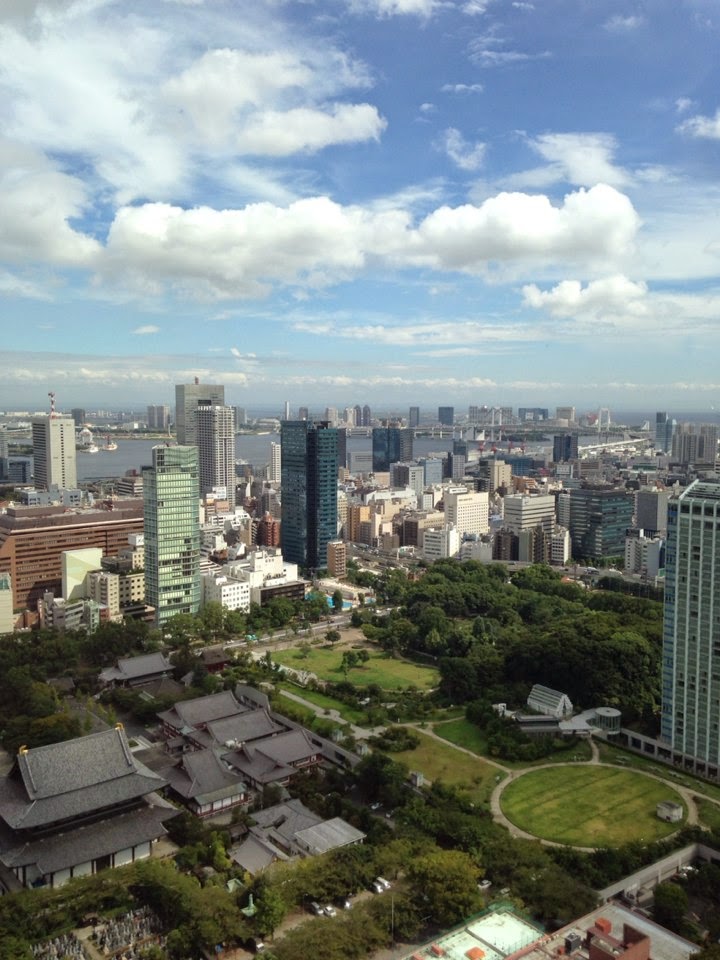
I had read a lot about Shinjuku before getting to Tokyo -- it's the place with all the quirky restaurants, they said. It's got so many arcades, they said. I'm sure they were right, but the arcades and quirky restaurants did not present themselves to us immediately after leaving the train station the next morning. In fact, Seth and I were staring at a map for a while in the skyscraper district when a very concerned-looking Japanese man appeared next to us. I met his gaze and he asked, "May I 'elp you?" He seemed really relieved when we eventually conveyed that we were just looking for the street where all the geeks want to go, known as Electric Street. "Ah! You can buy many things! Personal computer!" He exclaimed. He told us how to get there (which unfortunately included retracing the progress we had just made for ten minutes) and we were off. We walked into a random store and Seth lost it. I wish I could explain in Geek terms what I saw in this place, but I lack the will and interest involved in learning these things, so I'll just say it was really cool and full of things that Seth liked. There was a Playstation and Microsoft floor, a Nintendo floor, an obscure Japanese game floor, and a Lego floor. This was one building. Makes you wonder what else they could possibly have in the others, although the answer is probably the same stuff. Anyway we left that area and headed over to the Government Metropolitan, where we took the elevator up to the 45th floor and got some views of Tokyo from above. For free. I'll just go ahead and say we saw Tokyo from above THREE TIMES in two days, and this one was free. The other two cost money: the Tokyo tower, built in the '50s, was $9 to go up per person (another $8 for the higher level), and like dummies we didn't do our research for the skytree, which is just a newer fancier version of the tower and costs $20 per person. Another $10 if you wanted to go to the "special observatory" (HA!). I guess the skytree might be the tallest at 350 meters and higher, but if you're not really fixated on going up to the highest level in the sky possible, maybe stick with the freebie. We could still see Mt. Fuji from the Government Metropolitan. Or we could have theoretically, at least. It was a really overcast day.

We had an appointment at 1:30 for a tour at the Imperial Palace of Tokyo. It was free, but you have to apply in advance. It's the same deal for the Imperial Palace in Kyoto, which we were disappointed by when we went to Kyoto and Nara last year so I made sure to be prepared this time. What they don't tell you on the website is that the tour guide doesn't actually speak English, and also that the tour is actually a total waste of your time. Or at least it was not as exciting as we had built it up to be in our heads. Before the tour began, the guide instructed us to listen to numbers 1, 2 and 3 on our 1985 audio devices (with *one* clip-on earpiece) of an Australian woman who hates her job reading slowly into a microphone, and then he proceded to talk for another 15 minutes in Japanese after we had all finished number 3. We waited anxiously for the insider information to be translated, but it never was. For all we know, he could have said, "There will be a free puppy giveaway at the end of the tour for all who express enthusiasm at the north porch of the Fujiyama building" but we had no idea. That's basically how the tour went though: Quickly, he would say "audio numba 5 and 6." Then he spoke in Japanese for a really long time. The audio was a little helpful though. The Australian woman warned us to be really careful on the 15-foot-wide concrete bridge reinforced by stone pillars. "Be sure to stay away from the sides of the bridge," she said (you mean the sidewalk? Next to the stone wall?? ) "And taking pictures is strictly prohibited. Thank you for your cooperation." All the Japanese proceded to take pictures off the bridge. So we did too. And the officials smiled and nodded, but also made sure we stayed away from the dangerous 4-foot wide concrete sidewalk. She also instructed us to be sure to take care on the "steep" 20 degree incline. It was weird. The buildings were kind of old, but some had been destroyed and rebuilt in the '60s, which by the way was just a great era for long, boring slabs of concrete. Anyway, it would be really great to get those 80 minutes of my life back, but c'est la vie.

We headed north next to Akihabara, the "Electric City" part of town (not to be confused with Shinjuku, which has "Electric Street"). Basically there were several buildings with six stories or more, just full of arcade video games. We went into one of them, and after trying and failing at one game which involved large robot thingies running away from each other and being shot, we went a few stories up and did pretty well at a fighting game, where you basically just had to kick and punch your opponent over and over until you knocked them out twice and got to go on to the next round. I made it through 8/10 rounds! Seth made it through 7. Just sayin. Anyway he was happy, he'd gotten his fix after about 15 minutes. But full-on adults go into these places and just go to town on these arcade games, all day. Some of the floors at the bottom were pretty packed. On another note, there are also buildings full of Pachinko machines. What's Pachinko, you ask? Well, it's a slot game. I assume there's betting involved. But the Japanese (especially older people) are really into it. To the untrained eye, you look into the door of a building and it appears as though there's a line of elderly Japanese men and women just sitting in front of arcade games. Seth also looked for Hobby Lobby, which we found the next day with the help of another kind Japanese man who took pity on us gazing at a map for too long, and even guided us there after calling the number in the guide book to inquire as to the location. Um, I find myself at a lack of words again to describe Hobby Lobby. It's not the cool craft store I know and love from home, but rather a store of figurines and accessories for enthusiasts. Seth was so, so happy. I left after about 4 minutes to chill outside and study a map for our next plan of action, while a scantily clad cartoon girl band sang (loudly) and danced for me on several TVs in front of the store. That's right. I said scantily clad cartoon girl band. Just another day in Japan.
We went to at least three shrines in Tokyo. They were all very old, and very pretty (names: Zojoji Temple, Meijin Shrine, and Kanda Myojin) and they all had two giant pillars in the ground, with two more giant perpendicular pillars on top as the entrance gate (see below for a picture of me at the bottom of the Meijin Shrine entrance). I'm pretty sure they were all established before 1000A.D. but one or two had been relocated for one reason or another. We learned that Shintoism and Buddhism are very closely entwined in Japan, which is a nice example for the rest of the world to follow, I thought. It turns out the Japanese people kind of pick and choose from the traditions they like of these religions. For example, at a Shinto shrine, you would see the Buddhist tradition of writing a wish or intention on a wooden placard and hanging it up with the rest of them. Or at either one, you find the long sticks with a cup on the end next to spring water. We learned what to do with these sticks. You're not actually supposed to drink water from them (oops). In fact it's a very specific process. Take the stick in your right hand and pour water on your left. Then transfer it to your wet left hand and pour the water on your right. Then put it back in your now also wet right hand and pour water into your cupped left hand, then take that water into your mouth and swish it around, spit it out into your left hand again, then hold the stick up so the cup part is on top and let the water wash down and clean it and  your hands. Then replace the stick! See? Easy. There are also all these ceremonial rules about clapping twice and bowing twice in front of the shrine. Shintoism is about respecting kamis, who are ancestors that used to be really important people in life. I probably just completely over-simplified it and may have pissed someone off, but there's your summary of the combination of a wikipedia article and what we understood from going to the shrines. They have rules at shrines, like don't sit on the steps in front of them and don't stand in the middle but instead off to the side, as it's disrespectful (guess how Seth learned THAT rule).

Have you ever seen a TV special or story about Tokyo? What's the first thing they always show? That crosswalk, right? With all the people who go and traffic just completely stops for them? Well, we found the crosswalk and took pictures of ourselves walking through it like shameless tourists. It's called "Scramble crossing" and that's exactly what it is! That's all. We also went to the Yebisu beer museum (if you know any Japanese beer, it's connected with Sapporo). There was no English tour, but the tiny museum was pretty easy to figure out and we basically learned that Yebisu has done really well because... it's a German beer! They import all their ingredients from Bavaria and follow all the German beer purity laws. They even brought in German brewers when the company started in the 1890s. They had to phase themselves out in the second world war, but made a comeback in the '70s and everybody was happy. Afterward of course we had a beer and ate cheese! I love cheese. The cheese was good. OH CHEESE. Another thing we did was look for the Tsukiji Fish Market! At this famous, enormous market, there's an auction at 5AM every day to sell fish to restaurants and patrons, and it's very exclusive. Naturally there was no way I would get Seth up in time to go see the auction or to have sushi for breakfast, but we looked for it on Friday afternoon. I say "looked for" because SOMEBODY decided we shouldn't take a cab from Tokyo Tower; rather we should just walk since we were feeling better from the food poisoning. Well, this turned into a bad idea. We walked for about two hours. We made one or two large circles because of dead ends (that part was my bad). I knew we wouldn't be able to buy the fish, but there were restaurants inside the fish market that would probably have really good fresh fish! Well, when we finally found the entrance to the market, it turned out there were no drunk people or flip flops allowed (we weren't drunk; I just thought that was a funny sign). And the last thing we did in Tokyo that belongs in this "miscellaneous category" paragraph was go to Yanesen, the historical district. It was the final act on Friday night after two completely packed days of touring and I can't tell you much about it except that my feet hurt. And there were some cats. People sold things. Supposedly there was another temple but we had no more energy. I'm surprised we even went.

No Tokyo experience is complete without one last experience on a subway, crammed to the sardine level of crowds. I didn't have my 90L backpack, but I couldn't turn around. And this was after Yanesen, when our feet and legs were so tired we could hardly function. It was the longest subway ride of my life. Until we got to sit down when many people left and a million more got on. An old man stood in front of me as soon as I sat down and against my will I kindly offered him my seat, but he smiled and waved me off. I must have looked pretty rough.

Oh yeah, the food. I wish I had more to report about what we ate, but we literally had sashimi FOUR TIMES, in Tokyo alone. Sashimi is a form of sushi -- it's just a rice ball with a piece of fish on top. Once was at the same restaurant near our hotel. Once was at a made-to-order place (as opposed to the conveyor belt sushi bars, where your food just keeps coming to you with no end) and I now will never forget: raw and cooked mackerel, sea eel, the different colors of (especially red) tuna, snow crab legs, boiled and deep sea shrimp, raw salmon, and sardine! The sardine was not particularly salty. I feel like that should be known, and also as though I have been deceived. Otherwise we also had a "beef bowl," which is spicy, garlic-y strips of beef over a bowl of rice. I should emphasize "garlic-y," because I really tasted garlic for the rest of the night (that is until we ate sashimi again). Man that was good too.

So now we're on the train bound for Osaka, cruising through the Japanese countryside at around 150mph. One more night in Japan, and I'll have to write about that en route to Kathmandu tomorrow! The weather is not supposed to be nice, but I've been making silent deals with the Shinto weather kamis in my head and they've been coming through for me in Tokyo.
Sayonara! :)