Monday, September 22, 2014

Trekking and touristing in Chitwan

The last two days we spent trekking were awesome, and exhausting. The foothills of the Himalayas don't exactly have flat paths, so about 97% of the time you have to keep your eyes really focused on the ground so you don't fall (in a new record, I only got two bruises!).

Dat view tho

I took all of these pictures with my Samsung Galaxy S3 -- that still amazes me.
This is hard to do on a clear day because the views are so unbelievable, so maybe it was a blessing that we spent the first two inside clouds. The ground is usually made of a combination of stepping stones and dirt, but also donkey poop, yak poop, tree roots, and a never-ending incline or decline. Turns out, declines are really hard on your legs and feet. Here's a tip, especially if your shoes are a bit snug: make sure your toenails are clipped before going down a mountain for 2+ hours. Otherwise it feels like you're stubbing your toe, very softly, over and over again. Anyway, on day 4 of the Poon Hill trek we went to Jinadanda, where there were some marvelous hot springs. 

Very fabulous, and very much needed.
Oh my poor toes
Of course, after trekking for 5 hours we had to go down another half hour to get there, and then back up to the guesthouse afterward, but it was totally worth it and not so bad without a 15lb. backpack. Oh how our muscles needed those hot springs. We stayed until we couldn't get any more raisiny and the rain started rolling in anyway. The only other guests at the guesthouse were also at the hotsprings -- an Australian butcher and an Englishman studying to be a Civil Engineer, so we talked to them for a little while before leaving. On the way back up from the hot springs, we got our first leeches! When I first saw a leech on day one, I thought it was just a really quirky cross between an inchworm and a worm. I guess I'd never seen a leech before. Our guide got one on the first day and instructed us to dab salt on our boots and ankles just in case, which seemed to keep them away pretty well. We must be immune, we thought. But going coming back up from the hot springs in flip flops with no salt, they found me. I was lucky -- I only got three. One between two toes on my left foot, one between two toes on my right, and one on my ankle that didn't appear to break skin before I caught the little bugger. Interesting fact: they have gross little mouths on both ends, so if they get stuck between your toes, you can bet on the fact that they will biting both toes. Apparently they secrete an anticoagulant when they bite, so it's easy to bleed a lot when you take them off. The good news is, their heads don't appear to get stuck inside you like the common American ticks. The bad news is the whole two-mouth thing. So on my left foot, after I removed the leech from between my toes, I was bleeding more than I was comfortable with. I stepped in the shower when we got back from the hot springs and realized (1) the leech was STILL IN MY SHOE (luckily a flip flop), and (2) the reason I was bleeding so much was because he got me with both ends. Somehow it had stopped sucking -- maybe I injured it when I pulled it off or maybe it had just satisfied its appetite, but that was its last meal. I'm pretty sure it died a long, painful death, or at least I hope so. Anyway, the Australian butcher had it way worse -- either he wasn't paying attention or the leeches got aggressive, but either way at dinner, his feet looked like he'd gotten stuck in a landmine. While we were playing cards with him, a street dog tried to lick his wounds. He got spooked at the idea of infection on open leech bites and chased it out. It was a weird afternoon, but the relaxation was super welcome.

The last day of the trek, I was hurting. Seth was hurting too, but my backpack was really starting to piss off my back. Seth had had the same problem a few days before, and now it was my turn: a dull pinch inside my left shoulderblade kept screaming at me to stop moving. I tried stretching it out and bending over and Seth rubbed it for me, but I couldn't shake it. About 4.5 hours in, our guide said: "OK so now we can take the bus back if you want or we can--" I interrupted him with a resounding "YES. BUS." It was probably another 6 miles to go, and I was just miserable. Seth was a little disappointed but could see that if I had to walk for more than another 15 minutes I might just fall over, or go on a killing spree. He was nice enough to take my backpack for a little while, but then I was just in pain AND feeling guilty. We took a jeep back along the incredibly bumpy road, with the driver calling out to people on the side announcing our destination in case they wanted a ride, too, for a little cash. Everybody who joined in the jeep was afraid to sit next to the white people (us), so they crammed into the front and the trunk (which had installed benches) and we got the middle to ourselves. We didn't really shave much time off of what would have been our arrival time in Pokhara because the road was mostly potholes and big rocks, but it didn't matter to me -- I wasn't walking. We got to the hotel and collapsed. Then we went out and ate too much food. The next day was pretty much the same, except for a leisurely canoe ride around Fewa Lake and some shopping, but we definitely took it as a recovery day. We met some cool people at a restaurant that night and hope to meet up with them again in Kathmandu on Monday.

Fewa Lake!!

So Friday we hopped on a bus for five windy, bumpy hours along with all the Asians and backpackers to get to Chitwan National Park. This is an area with lots of animals (rhinos, crocs, elephants, birds), the point of which is to encourage the propagation of these endangered species, which has overall been pretty successful. Our guide at the hotel was 26, and he explained that up until he was 16 he lived in a house in a tree (maybe he meant on stilts) inside the park until the government forced the local population outside of the reserved area. He didn't seem too bothered by this, since apparently the park is doing pretty well. He took us out to see a "Tharu traditional village," i.e. a string of mud huts where the Tharu people were living, probably not dissimilar to the style he used to live in. A manager of the hotel explained to us that the Tharu are another Nepalese ethnic group and caste, who have their own language and religion and set of skills. All the castes in Nepal also speak the common tongue, i.e. Nepalese. But they can't understand the languages across castes. Turns out our guide on the trek, by the way, was not a Sherpa but rather a Brahman (guess I'll need to edit that other post), which is a higher, more educated caste. It's all Nepali to me! The cooler thing though, was the man on an elephant just walking down the street. It was a big elephant, too and it wasn't like an "elephant street," but rather a real (albeit not very crowded) paved road where cars and horse-drawn carriages and bicycles ride, just this one also had an elephant. Apparently this is a totally normal thing in Chitwan. Then we watched the sunset by a lake next to some loud Indian men with beer bellies who kept spitting. After dinner with the group of ten Koreans who were also staying at the hotel for the same package deal -- can't seem to get away -- we saw a Tharu traditional dance, which was pretty cool: a bunch of people dressed in white tribal costume were playing drums and singing and dancing with sticks, choreographed perfectly so that their sticks hit each other to go with the beat of the music. So I guess you could say it was like Stomp.


So, after a lovely evening of traditional dancing, and more Chinese tourists with super-flash cameras, we decided to hit the sack. We were supposed to go on an elephant ride at 6 the next morning. The next morning, of course, was raining cats and dogs, so, like fat, American, pig-dogs, we slept in. The staff looked: a) perplexed, b) distraught, and c) unbelieving that we didn't want to go in the rain. We assured them that everything was fine and we simply didn't want to go out in the rain. We'd had plenty on Poon Hill. We spent the better half of the day reading, and trying to find a signal to the outside world. In hindsight, smoke signals would've been easier. But, time passed and we were geared up to go bathe some elephants instead of ride them. 


Now that was cool. We both climbed onto the back of this mighty beast while a whily Nepali man danced on the elephant's butt to give it commands. At one point, I swear to God, he yelled out, "Pizza Hut!! Pizza Hut!!" If I'm ever a mahout (fancy Nepalese for "elephant trainer"), I'll try out that one. The elephant was accommodating, to say the least. It's not often we have to take a bath while smaller animals sit on ours backs, and they are deceptively hard to sit on. Multiple times we would fall off into the water because the elephant would tilt its shoulders. We were pretty sure that was how we were going to die. We could already see the headlines: "YOUNG AMERICAN COUPLE SQUISHED BY NEPALESE ELEPHANT." Afterward, we posted up in some lounge chairs and watched more tourists take a crack at the elephants while we dried off in the sun. We sipped some more masala tea and thought, while watching the other people, "damn, we forgot to scrub the elephants!" because the whole idea was an elephant bathing. But oh, well...

So, we headed back for lunch, which wasn't quite ready, so we went to the Mom n' Pop store about 20 feet outside the gate to see if they had a little something to hold us over. We found some cookies and chex mex-looking stuff, and got that. Later, we ate lunch and headed back to the room. After some resting, we took a jeep to the breeding center and it was. So. Cool. Our guide explained that the elephants usually do work in the morning (like elephant rides), then go out into the jungle with the staff to play and eat, and then hang out at their posts under roofs for the rest of the day and nighttime. They are chained to posts, but he also explained that the breeding center will soon start to integrate an electric fence system so they're not so bored. We learned a lot, like how an elephant's trunk has 40,000 muscles. Also in Chitwan, a lot of the elephants are wild and come impregnate the females they raise. So usually there's a baby at the center, and the one we got to see was just a week old. He was hanging out with his mom next to her post (he wasn't tied up) and just kept slipping and sliding in her poop. We could have watched the baby all day. Sometimes he would fall down and his feet would be splayed out like a ragdoll. Well, you know, an elephant ragdoll. Then he would get back up and nuzzle his mother before going down the poop slide again. Once the babies become more independent, the guide explained, they have to be tied up too, because they get "naughty" and go around bothering all the other elephants or get too close to the tourists. I was sad to see some of the younger ones getting annoyed and trying to pull themselves out of their ankle chains, but relieved to know they were doing other things in the day and also the breeding center seemed to be doing their best to keep the elephants happy and healthy. We went out on the town for a dinner at a place called K.C.'s and then got a great look at the Milky Way on one of the rare clear nights we had in Nepal.

The next day, Damo our guide took us on a nature walk (apparently still distraught about us having turned down the rainy day activities) and showed us another side of the breeding center, but also taught us a lot about the distinct flora and fauna of Chitwan. He showed us a "sighing plant," which is a little round pink flower which looks like a spiky ball, with leaves that look like ferns. You touch the ferns, and they immediately ... well, sigh. They fold up. It was amazing. I kept doing it. Seth had to tell me to stop because Damo was waiting for us and I was going to leave the whole patch of sighing plants without an open fern. I'm sure they open back up soon afterward.

We took another long, bumpy, windy busride back to Kathmandu on Sunday, went to a restaurant called "Rumdoodle"where we decorated a small cardboard Yeti foot (apparently a very popular activity), and then spent the last 24 hours we had in Kathmandu repacking our bags, sending stuff home, getting pedicures and henna, and eating all the authentic Nepali food we could before taking off for Vietnam. Next stop Hanoi! ... Hello, Hanoi! (Don't know any Vietnamese, shoot...)


cool Chitwan mosquito net!


Apparently we didn't take so many pictures in Chitwan. I think we were too exhausted.

Wednesday, September 17, 2014

Stairs, stairs, and more stairs. Oh yeah, and the Himalayas.

The night before our first trek out of Pokhara, we went out for dinner and ate wild boar curry at a happy hour at a bar we found which was playing live music and offered lounge chairs on the terrace overlooking the lake. It was dark, but we could still see little lights on the other side of the water of families who live in these incredibly remote areas on mountains. We also accidentally ordered two drinks each, but c'est la vie. Then we ordered one more because it was still happy hour and a "dirty banana" sounded like a really good investment (it was). Pokhara is a charming little area, and much, much cleaner than Kathmandu. They apparently also have power outages, but the hotel we got uses a back-up generator for those several hours per day. Despite the fact that it sounded like there was a truck waiting outside our window to take Dumbo back to the jungle, it was still nice. It's almost like a beach town, with a lot of tourists and a strip of hotels, restaurants and shopping, all next to the enormous Fewa lake. A little more laid-back than Kathmandu, much less crowded and much less polluted. We liked Kathmandu a lot, but I could feel my throat starting to react to the extreme amounts of exhaust you constantly breathe in there, along with the incense and ... occasional monkey poop. The weather was beautiful that day, so of course we went out without our umbrellas and decided to go for a post-dinner stroll. And of course it started raining exactly when we were about to turn around, about 15 minutes away from the hotel. It came down, though. The Hindu gods were just urinating all over us. It didn't let up, so Seth and I walked back to the hotel in the rain, just accepting the fact that we'd have to let the sun dry our clothes the next day on our trek. Because of course it would be sunny. Right? 

Wrong. The first day, we walked for 3.5 hours, and it came down in buckets for approximately 3. Eventually Seth and I accepted the fact that we'd have to pay too much money for a big plastic cover for our backpacks, and also that we'd have to use our Japan-level tiny umbrellas. These things were made for chiwawas, I swear. We figured out how to jerry-rig them to our backpack straps and attach a giant piece of plastic to each of our 20-pound bags, and set off.

A rare moment of less rain

The path that day was mostly dirt road for jeeps with some gravel, with pretty easy inclines and eventually amounting to 500 meters that we climbed over the course of three hours. It was a breeze (except for the whole swimming through the rain part) and we thought:"This is going to be too easy. We should have gone to Annapurna base camp, or Everest base camp! We are such good hikers." We ate lunch and dinner at our first tea house (tiny hotel area), witnessed a Buddhist ceremony performed by Tibetan sherpa monks for a reason I still don't really know but has something to do with a rite of passage maybe, then spent the night at the lodge where we ate and read books.

Rite of passage or naptime? Either one sounds pretty cool.

A few people we talked to said they were nervous about the next day. Something about stairs. We shrugged. We'd just climbed to the top of Hideyoshi Toyotomi's tower a week before, and that was eight tall floors! We can do stairs. Wrong. The next day, Reywati our guide took us to a place they call the THREE THOUSAND STAIRS. I have no idea if that number is accurate, but god did it feel like it. Try to imagine big slabs of rock. Now, imagine them in stair form. Now, imagine you are going up these stairs, and every time you think you see the end, it's not the end. Imagine doing this for FIVE HOURS. I'm being conservative here, because we hiked for about seven hours (starting around 7:30AM) and we didn't climb exactly that the entire time, but it took up a good chunk of the time. Also, because of global warming, monsoon season has not been as predictable as normal. Usually in September, the skies would be at least mostly clear and we would be able to get some kind of visual reward for hanging out on the never-ending stairclimber. But instead, we were inside a cloud. The whole time. It didn't rain as hard as the day before, but it drizzled, and we couldn't see more than about a 25ft radius from ourselves. Reywati is very kind. He's about 5'3'' and has a body built like a soccer player (although his sport of choice is Nepal's national sport kobardi, which involves running into another team and holding your breath until you reach the finish without getting tackled to the ground, but I digress). The point I'm trying to make is that this is extremely easy for him. He's not even wearing hiking shoes, but rather shoes that resemble crocks which he uses to walk through water and kick heavy rocks into a safer place for us to step on while holding an umbrella (and while we wobble on rocks across streams). After the first two hours or so, Seth and I wanted to fall over and attack the next donkey we saw and eat the whole thing. He hardly broke a sweat. He looked so bored going at what I've named his "tourist pace," but didn't seem to mind and has been carrying a bunch of apples and pomegranates for the two fat Americans to munch on for when we start to whine that our feet hurt.

Even though the path is mostly stairs, we were really surprised at how well-maintained it is. Reywati explained that it's the "main highway" from the bottom town of Noyopool to the Annapurna base camp. Then how, I asked myself at first, do they actually make BUILDINGS of concrete with restaurants and beds and tin roofs and toilets (sometimes)?? Well, my question was quickly answered after we passed the third group of five to ten load-bearing donkeys being herded up the mountain. Basically what happens is they each get about 60kg (130-ish lbs.) of stuff, and then a guy in flip flops walks behind them, whipping them with a stick or a whip if they take a break when they're not supposed to.

Badass donkeys coming down asshole stairs after a trip up asshole mountain

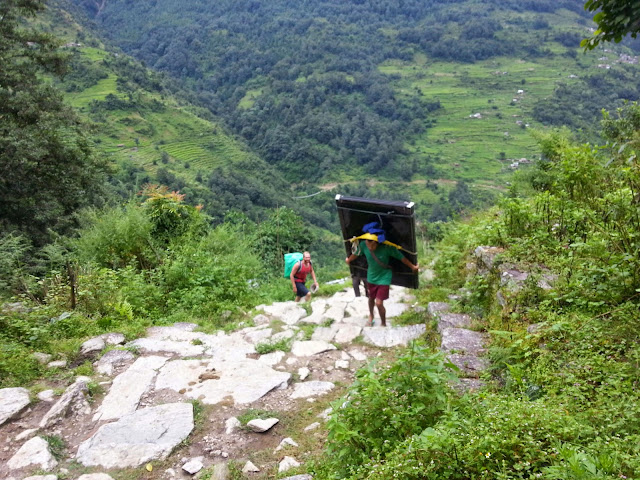
Also, porters. Porters are guys who carry lots of weight (up to 45 or 90lbs depending on the area) for any purpose. You can hire a porter if you're hiking and you don't want to carry all your stuff and he'll take your backpack, or if you're building something like a guest house on the mountain and the donkeys can't be trusted to carry the enormous windows because they might break them. So how, you might ask, do porters carry these heavy loads up the mountain? Well, that's a great question. They strap the loads to their foreheads. At some point the cost-benefit ratio of putting a backpack around your waist with the straps doesn't cut it anymore, so they do it the traditional Nepali way: they have a basket, or a backpack, or in some cases a big glass window pane, bring a strap around it and fix the strap on their foreheads (sometimes with a folded towel under it to make it more comfortable), then just bend over a little and voila. Don't try this at home kids: foreigners trying to do it have broken their necks, since any movement in a particular direction can literally paralyze you. It's amazing to see and I know it's their job, but I'm really glad we didn't hire a porter because I would feel like a total asshole watching someone else carry all my stuff by their forehead. The tops of my hips are starting to bruise from my own 20 pounds of burden, but I definitely don't want to triple or quadruple that onto someone else for my own comfort. Usually though, it appears porters graduate to guides like Reywati, whose job now consists of babysitting foreigners on long hikes to see outstanding views and getting free room and board on said hikes, which beats some other jobs.

Badass porter and Seth with slightly less badass 20-lb. backpack (also notice asshole stairs)

Anyway, this morning we woke up in Ghorepani at 3:45 in preparation for a clear sky to watch the sunrise from Poon Hill. We had climbed 1,300 meters the previous day, then we hiked another 400 by the light of the moon for an hour to witness a view of a section of the Himalayas with about 50 to 75 other tourists. It was spectacular, and perfect timing for the only clear skies we've seen thus far, in all three days we've been hiking. We saw Annapurna 1, Fishtail, Dhaulagiri 1 (which is over 8,000 meters) and several other mountains I really couldn't remember if my life depended on it.

WE MADE IT TO MOTHER F-ING POON HILL

We must have asked poor Reywati the names of these mountains about 47 times, but eventually we just took a video of him telling us the names again so we wouldn't have to ask. We could have seen even more if there had been even fewer clouds, but we took what we could get. It was the reason Seth wanted to come to Nepal, and thank Buddha (or Vishnu, or the Shinto kamis or whomever) he got it. I did a timelapse photography of the sunrise and it turned out really well.


Then we walked down 400 meters back to Ghorepani and had breakfast. And then, guess what?? We went up another hill, for an hour, and got to the same elevation as Poon Hill. Rephrased: This morning, at 4:30, we walked up 400 meters, saw the sunrise, went back down, ate breakfast, AND THEN WE WENT BACK UP. Oh sorry, THEN WE WENT DOWN. Very far. For two and a half hours. Oh yeah. THEN WE WENT UP. For another half hour. My butt muscles are so pissed off. And so are my feet, from going downhill for so long.

So, so tired.
Map of Poon Hill Hike (which we are doing, in case I did not make that clear)

And that brings us to our guesthouse, which, as we've officially come to expect from Nepal, has very steep stairs. Up to the room, then back down a hill and up a hill again to the dining room for dinner. Then back down the second hill and up if the first you forgot anything (phone charger), like some kind of cruel joke. I can't believe I will be doing this again tomorrow. But! We shall be rewarded at the end of the day with hot springs.


Some observations on the point of view I have acquired:
- I get excited when I get to sit on a toilet, instead of squat over it. If it flushes (instead of having to scoop water out of a bucket and doing a manual flush), well, I feel like a queen. Especially when I remember to bring toilet paper. Last night we had our own private toilet and gas powered-shower, and it was glorious even without the sink. Oh, but we had to turn on the gas out of an enormous gas container, then one of us had to hold a button because it was broken while the other showered, and vice versa, and then we realized we didn't have towels and the room was freezing, so we had to use our sarongs then hang them up to dry. But still... private toilet.
- Even here, in the foothills of Nepal, in a village that can only be reached by foot, yak or donkey, THE BEDS ARE STILL MORE COMFORTABLE THAN IN KOREA. I would just like to say, that's pretty sad, Korea. Maybe some food for thought.
- New foods I love: yak cheese, Tibetan bread, roasties (big fancy hash browns), and curds with fried things.
- The caste system is very prominent here, and effects everything. This probably doesn't surprise a lot of worldly people, but Reywati explained that since he's a Brahman and the highest caste, he will sacrifice a billygoat (or several) during their holiday Gadhimai in October, whereas lower castes will sacrifice a yak which they can share with other families. (In Gadhimai, animals are sacrificed to appease the gods, then eaten. We're talking lots and lots of animals.) Also he didn't really understand what was going on in the Tibetan Sherpa ceremony because it wasn't his caste, and different castes practice different forms of the same religion. There are 104 castes in Nepal. It's all very fascinating.
- It's totally normal now for us to see a chicken or ten just kinda wandering around outside a restaurant or a store or guesthouse. Also, cows. Not in the mountains, but cows hang out everywhere in Pokhara. Goats, donkeys sometimes ducks and buffalo, roosters waking us up (whenever they want, not just at dawn): these are all completely normal parts of this surreal life we have now gotten pretty used to.
Next time we write it will be done from a hotel room in Pokhara, in two nights. I'll have another update then! :) Seth slept through the entire making of this one so maybe he'll have more to say then.


And now, a few more pictures...

There is a mountain there.
Holy cow, right??
Pano shot with a lost explanation of which one is Anapurna II etc. somewhere in my memory card


Seth in his hiking boots and Reywati in his crocs, on the way down from Poon Hill (dat sun tho)

Friday, September 12, 2014

Bhaktapur and Paradise in Pokhara

Good news everyone! Tomorrow we will set out on a trek near the Annapurna Mountian Range. The trek is called Poon Hill and it's super popular among backpackers. Our itinerary is as follows:

Friday: fly to Pokhara
Saturday through Wedensday: trekking from Mayapul, Ulerig, Ghorepani/Poon Hill, Shinadanda, then back to Mayapul and Pokhara
Thursday through Sunday: sightseeing etc. in Pokhara and Chitwan National Park
Monday: Take a bus back to Kathmandu
Tuesday (the 22nd): off to Hanoi

We are really excited and relieved the rest of the trip was planned for us by our trusty hotel owner and his trekking experience and connections. Our wallets took a beating, but that's why we're on vacation! When we get back Seth wants to go see the Himalayas in a plane! We'll see how the weather is, and how our wallets are feeling then.

So now, the past few days in a nutshell:
To recap Thursday, we went to Bhaktapur. Similar to the day trip we took to Patan, Bhaktapur is another ancient city which we're super glad we saw, even though there's a lot of tourist-specific pricing. The buildings and temples were impressive and beautiful. They are medieval in origin, and Bhaktapur acted as the captial/central hub of Nepal from the 8th to the 15th century. Our cab driver, who we met taking us to Patan, drove us to Bhaktapur and gave us some tips on the city. He explained that since the Nepalese government is fairly corrupt (and what government isn't nowadays?), it jacks up the prices for tourist spots all over the country. So, like before at Pashupati, it cost a certain amount per head to get in. Our driver, Assok, told us how to get around these rules and get into the city, undetected, which was super cool of him, since we were trying NOT to bleed money.

Patrice in front of a super old temple
We wandered down an alley or 10 before we got too lost. We came up to an alley that put us right next to the entry gate: much too close to not be seen. So, we sighed, and turned around to start walking the way we came, and then heard a "psst." We turned around and one of the elders sitting on platform motioned for us to go just around the corner. The 5-year-old nearby old confirmed his instructions with a nod of his head. The people of Bhaktapur had come to our aid!!

So, we made it in, no problem, and then walked through the city, meandering and taking pictures of all the cool old buildings and streets. Unfortunately, we turned down the wrong street for some street samosas and missed the gate (those samosas were like a damn delicious Nepali poison apple). A guy stopped us and said we needed a ticket, so we said, "ok, we'll just leave." We then walked the perimeter of the city trying to find our new way in, but eventually found our way back to Assok at the taxi spot. We were pretty defeated and were ready to go back to Kathmandu. Assok could see that we needed a morale boost from getting caught, so he suggested going south to see the pottery market. So, we did.


Scenes from Bhaktapur
Even more cautious than before, we snuck through even more alleys to find it. I guess the potters hadn't set everything up yet, but there was an old man making clay bowls on his spinning wheel. It took him about 30 seconds to make one and then start the other. An efficiency unequalled. We walked another 50 feet up the hill to Taumadhi square. Like nervous little squirrels, we peeked around the corner expecting a gaurd, but...there was no one there. But there were the most impressive temples I'd seen thus far. I forgot to mention, the whole morning the sky was overcast, but by the time we got to Taumadhi square, things started to clear up. We could see some of the mountains that cup the valley and had an even better view from the top of the largest temple:

(Patrice provided for scale)
We walked to the cafe next door and ordered lunch: our beloved masala tea, and aloo paratha (like a quesadilla with curds) and the other was paratha (fried naan/bread) with a curry soup. Of course, it was the best food ever. So, with our bellies full, the sun shine doing its thing, the incredible sights and ambiance to keep our zen thing groovin', we quickly got the morale boost we needed. 

We then hopped back in the cab with Assok and drove back to Kathmandu. While there, we found out that one of the guys who always says hi to us in the morning was the owner of the hostel. Not only that, but he also had a trekking business. So, we stepped into his office and set everything up in about an hour. Awesome! The remainder of the evening was spent with our new friend, Saurav, who took us out to try some momos (like really good dumplings) and tongba. Tongba is a lot like Argentinian mate (a tea), where there are ground up leaves and you put hot water in them and then drink the liquid out of a straw that has a filter on the bottom. Except tongba has millet, and it's alcohol! It was delicious, tasted a little like Japanese sake, and would have been even better if it had been cold outside. Anyway, Saurav is the cousin of my Aunt Patti's friend and colleague. He's a really cool dude, and we like him, so you can too! He too, as it turns out, runs a travel agency, so if anybody interested in going anywhere, we know a guy. The name of his company is Caligo. He's on facebook.
.
Drinking Tungba!

So that takes us to today. We got up this morning and left about half our possessions in the care of Trekker's Home, the amazing hostel to which we shall return when we spend our last night in Kathmandu. This way our bags only weigh about 16 pounds, as opposed to the 35 we had before. Anyway, this morning we took a plane to Pokhara -- oh I'm sorry, did I say we "took a plane"? I meant we climbed into a tin can with a bunch of Koreans out of a really sketchy domestic airport. Actually it wasn't that bad. The plane was 3 seats across and had a really nice flight attendant who happily gave us a caramel, peanuts and fanta! Also, and this is very important for people who have known Seth for a long time: the name of the airline was Yeti Airlines. No joke. The yeti is supposed to have been "seen" or "tracked" in Nepal so I guess a smart person decided to capitalize, and what a great decision. I also wanted to share that the first woman of three patting me down at the airport -- there was no metal detector -- found my bag and said, "This no. What is this." I said, "it's an ostomy bag." "Money bag? No." She indicated I would have to take it off. "No." I said. "POOP BAG." Confused, and possibly a little terrified, she waved me through.

The views of Nepal from the plane were breathtaking. I mean wow. The lush, green mountains all peaked right into the clouds. Some of the water was extra blue. Sometimes we were flying just above the elevation of the mountain peaks. 


Pictures obviously do no justice.
The hotel is $35/night and it's the biggest, fanciest one we've seen on our entire trip. We have a guide who picked us up from the airport and took us here. His name is Reywati. HE IS A SHERPA. Look, the only thing I think of when I think of Sherpas is Owen Wilson's character on Zoolander who is walking through his reallly awesome house and introduces Zoolander (Ben Stiller) and their friend to his Sherpa buddies, wrapped up in really warm clothes and chilling together. So to meet a real Sherpa and know we're going to be hanging out with him for the next 5 or 6 days and he's going to be telling us about all the effing amazing things we're seeing, well that just makes me really stoked. In fact, as I write this I am sitting on the balcony at our hotel and I can see an amazing screensaver-worthy mountain poking up behind the green one in front of me.

EDIT: Reywati is a Brahman, which is the highest Hindu caste. It sounds cooler to have a Sherpa, but is more realistic to have a highly-educated person who can speak English. Oh well, we really like him so he can be whatever the hell he wants.

Don't mind the awkward infrastructure, it's actually really nice here.

 I saw Reywati walking up to the hotel. I pointed out the mountain and he told me the name: Fish Tail, and that it's 6,000 meters high. He knows all the elevations we'll be walking to (up to 3,210 meters) and apparently all the names, too. He's been to Everest Base Camp, up to 5,000 meters (of course he knows the exact number but I definitely don't remember) and he doesn't need oxygen at that elevation because, and I want to be very clear here: he is a Sherpa. His English is great. We took him out to lunch and then he showed us around a temple on an island on Fewa Lake, where a monk put rice with the red powder on our heads again.


 Fewa lake, by the way, is also gorgeous. We have gone from beautiful, polluted chaos in Kathmandu directly to paradise in Pokhara. In fact, if the name "Paradise in Pokhara" isn't the title of something, then nobody has been paying attention.

Well, we're off tomorrow! Not sure how much wifi we'll be getting on Poon Hill but Seth and I will be sure to keep a record of what we do. 

Wednesday, September 10, 2014

Temples, Stupas, and Hinduism 101

Hey gang, Seth here. I'll be recounting our exploits for day two so Patrice and nurse those typing blisters (she doesn't really have blisters...I'm...I just wanted to be funny. Please like me...)
So, after one heck of a start, we took a much more zen-like approach to Nepal and put the high-octane, let's-get-destroied-by-a-mob level adventuring on the backburnner. We transformed and rolled out of the hostel around 9am with a burning purpose: find the fabled Swayambhu Temple (a.k,a. the "monkey temple.") We asked our intrepid hosts of Trekkers' Home hostel, "what's the direction we should head in?" and, ever stalwart, they told us to head south...ish.

We were determined to hoof it, because the map said it was close enough, and we did just that. We do have a reputation to uphold now. Our trek was, like it's predecessors, "memorable." We found a path less traveled by non-locals, over a river, ponds of mud and a construction site that wasn't totally unlike a war zone. Patrice broke in her new sandels reeeeaaaal quick; however, after about half-hour of finding routes through peoples' yards and driveways, we made it to the steps of Swayambut.
Like any place a tourist might visit, the steps were crawling with beggars and touters. We are no strangers to these sorts of things, so we, unphased, marched on. We mad a pit stop after the first 50 steps or so for some fresh watermelon and bottled water. Nepal's climate isn't exactly what I had envisioned it to be. Instead of cool and perpetually breezy, it's hot and muggy AND I DON'T LIKE IT!! Anyhoo, the gentleman selling the fruit and water kindly warned us about the monkeys that would, understandably, attempt to rip the tastey fruit from our unsuspecting hands. No sooner had he said that, we heard a rustle in the tree above. At least 6 hairy little imps were staring holes through our watermelon. I told Patrice, "eat quick," but just then, the fruit-man whipped out his trusty slingshot and fended off our evolutionary cousins, lickity split. Hilarious!
So, after properly hydrating and Patrice having had her fruit fix, we climbed the rest of the stairs. We didn't count, but we could make a conservative estimate of 200+ (rather steep) stairs in total, but that's what it takes to see the entire Kathmandu valley. The view, for a lack of a truely better word, was stunning: mountains that put my beloved Appalachians to shame form a momumental bowl to cup the lush, green, and very urban valley. Clouds rolled across the sky like waves on the ocean and a moderate breeze kept the uncoutable prayer flags aloft and the humidity to tolerable levels. Swayambut is a "stupa," a style of shrine that Patrice will explain in Day 3, which stood an additional 40-45 feet tall and was adorned with the ever-vigiliant eyes of Buddha. We shopped for nick-nacks around the stupa and had a lunch equally as pleasing as the view on one of the local cafe's rooftops. Picture provided.
We finished lunch and headed back down the stairs (in hindsight, I guess we forgot to count them twice...) bought a small "singing bowl", which is a meditation bowl made of 7 silvers. You rub the edge of the bowl with a wooden pestle and makes a pretty tone. Then we caught a cab back to our hostel in Thamel, the touristy area. There, we regrouped, dropped off our treasures, and decided on Pashputi (another local temple) as our next destination. Unfortunately, nothing we looked at about Pashputi said, "NO FER-NERS ALLOWED" so, our very non-Hidu selfs were denied access and ushered over to the kid's table equivalent of the compound. We could check that part out, no pro-blamo, ...for $10 a head. Yeah, I don't think so. Only slightly perturbed, we walked to the other side of the road as Pashputi, to see what, if anything, was worth looking at. We found another, small temple with immaculate woodwork and got a small bag of samosas and fried dough for 50 cents. We walked, and munched, and realized, "there's nothing here for us to tour...", so, we turned around and walked back to the street. One last beggar met our eye, so I gave him what was left of our snack. I told Patrice that I felt a little bad for giving the guy our half-eaten bag of food, to which she replied, "yeah, well 'beggars can't be choosers!'" OOOOOHHHHHH, SNAP!!
Well, I thought it was funny...
We quickly found a cab back to the hostel and decided to explore the immediate area (i.e.- J.P. Road). The road is basically a backpackers candyland. I kinda felt like Charlie when he found the golden ticket. We got some shopping done and got to sit for a quick drink in a beautiful courtyard down a little alley to finish off the day. We both were in agreement that we had a much more enjoyable experience since we set our own culturally-driven pace as opposed to the afore-mentioned "high octane" one. I think we found our status quo.
I'm Patrice and I'm back! Isn't my fiance entertaining? Well anyway. The next day we headed off in a cab to Patan, a little city a half hour south of Kathmandu with some pretty great stuff. As soon as we got to the Golden Temple (one of those cool things), a short, friendly Nepali gentleman greeted us, who said he worked at the temple. We paid 50 cents to get in, so we figured he was just a tour guide. In the end we were wrong (again) but he accepted $10 graciously from us, instead of cheating us out of $60 worth of groceries, phew! He was really, really Hindu: a vegan who never smokes or drinks, and is just one of the at peace people I've ever met. He explained many things, but most notably the circle of life in the Hindu faith (I included a picture from google because apparently I forgot to take one): Divided into six parts, heaven is the pinnacle of existance; very good people go here, and become gods. At the bottom is the Hindu hell, which is pretty similar to the Christian idea of Hell: fire, brimstone, eternal suffering, etc. On either side are two additional sections: one one side right below god is the level of "demi-god," where humans go if they are exceptional in the previous life, but not so great that they are godly. The demi-gods and the gods argue over a fruit-bearing tree that connects their sections of the wheel. The gods claim that the fruit is reserved for them, but the tree grows out of the section of the demi-gods so they feel they have a right to the fruit. Anyway, the section below the demigods is the section of animal life: if you aren't kind to animals (like if you're a butcher), you go here. There are about 80 different levels of animal, monkey being the first and dog being the last because dogs are so compatible with humans and loving. After you finish the life as a dog, you go back to being human and are eligible for the demi-god or god level, depending on your accumulated karma as a human. If you're a bad human again (you get two chances), you will go to the level below the humans on the wheel: hungry ghost. This level sucks. It's kind of like purgatory. You have to spend a lifetime in perpetual thirst and hunger as punishment for the bad karma you accumulated in your previous life. If you eat or drink anything, you die immediately, which means you probably didn't have enough time to make up for the bad karma, so you go to the bottom of the wheel of life (i.e. Hindu Hell). In the middle is a depiction of hen, a snake and a pig, symbolizing lust, ignorance and laziness respectively. The goal is to eliminate these vices. Buddha has none of them, which makes him the head hancho (Hinduism treats Buddha as one of the Gods).
Our new friend also showed us his physical-chakra therapy practice using the singing bowls, and demonstrated to us how they (allegedly) help with ailments. Basically, the shape and craftmanship of the bowl give it particular vibrating properties, which massage the body. He demonstrated this by filling one of the large meditation bowls with water and ran a mallet around the rim to make it "sing." The sound waves bounced through the bowl and made the water jump like little fireworks. He explained that since the human body is predominantly water, the bowl's vibrations create a similar effect with your body tissue when you hold the bowl up to the body and vibrate it, enabling the body to relax, thus opening your chakra. We're not sure how much of it we buy into, but when our friend demonstrated this on us, we did feel good and relaxed, and also really in-the-moment, similar to how you would feel if someone gave you a quality back rub. He then explained the seven chakras: you have a crown-of-the-head chakra, for your brain and thoughts; your third eye chakra for healthy eyes, ears, nose and mouth; your throat chakra, for a healthy voice; your heart chakra, for a healthy heart and lungs; a chakra below that for kidneys and spine; a chakra for your intestines; and a chakra for your lower extremities. He also explained that the right side of your body is the male energy, and the left side is the feminine energy. Thus according to legend, Buddha was born not of  traditional delivery, but rather was born through the left armpit of his mother. Yes. I said armpit. Not kidding. But when you think about it, this is all not wholly dissimilar to Christ's virgin birth.
The last thing our friend taught us was about prayer wheels. They're everywhere here around temples and stupas, and basically you are supposed to walk clockwise around the structure in question and spin them as a form of meditation. They're pictured below in a few different places. We've circled several temples and stupas now, making a point to spin all the prayer wheels. And I can confidently say we at least partially get it. There's something extremely peaceful about just walking and spinning one prayer wheel after another, after another, after another. I'm sure we've just dipped our toes into the ocean that is Hinduism and Buddhism but Seth and I have both just really enjoyed zenning out with it. There's a meditation song that's always played (and sold on CDs) around these temples, and I found it on  youtube! So here it is:
http://m.youtube.com/watch?v=gx1SrxDwxXo
The words are "Om Mani Padme Hum" (just like the title, duh) and bring it all back in a ... CIRCLE... (eh? Eh???) those are the names of the different stages of life on the circle of life.
Finally, after seeing some more temples in Patan and drinking some more masala tea (we are officially hooked on chai), we headed over to the Boudha stupa. A stupa is like a burial mound for the creamated remains of significant individuals, and you can usually find one in front of every Hindu temple. The more sacred you are, the bigger your stupa. The Boudha stupa supposedly contains some of the ashes of the Buddha himself, so you can imagine how enourmous it is. According to the pamphlet, whoever walks around it (which takes about 6 minutes, as long as you don't stop to buy anything, which is hard) enough times, or does enough nice things for the stupa, will get what they want in the next life or just get their wishes granted. Just a preview of a very big paragraph: "All of those who circumambulate it will acquire the seven qualities of the higher existences. Whoever makes entreaties to it will effortlessly accomplish the two purposes. All of those who make offerings to it will be born in a place that knows no drought. Whoever offers flowers will be sure to obtain an excellent human birth with al of the conditions required for the practice of Dharma." Etc. etc. etc. It goes on and on.
So that brings us to now, Wednesday morning. A few cultural observations before I... PEACE OUT. Oh man I have to stop.
- They turn off the electricity twice per day, city-wide here, for about 2-3 hours. These hours seem to rotate (every day each one starts about an hour earlier), but luckily they don't turn off the wifi in the hostel. Everybody seems to have a back-up gas-powered generator for the necessary stuff during those times.
- On a related note, our hostel has one functioning outlet, and Seth and both use our devices a lot for reading, taking pictures, writing the blog, etc. So we are constantly charging something, when there is electricity anyway.
- Our hostel room is old. The ceilings are high, the wallsare eggshell blue, we have a wooden wardrobe and an enormous window overlooking the street of Thamel, and the window isn't very sound-proof, so we always hear something like honking or pigeons or rain. There's a fan on the wall, and a non-functioning outlet below it, but the fan chord doesn't seem to be able to reach the non-functioning outlet. I don't get it. We also have a huge skeleton key for getting in and out. Honestly, I love it. Ants and all.
- Someone tried to sell Seth drugs! Actually three people. Within about thirty minutes That's pretty common in this area. There was a cop right there. Seth told them to get the hell away from him.
- Just like your favorite yoga teacher, everyone, EVERYONE here greets each other with "namaste" and then says it when you leave too, like a "peace be with you" kinda thing.
The Bouhda Stupa
A Hindu monastery
Prayer wheels
Swayambut,  or monkey temple
Lunch on top of Kathmandu: goat cheese and tomato salad, curry, chai tea. Amazing.
tside a temple
More prayer wheels
Chakra therapy
Prayer flags and people at Swayambut
Swayambut

Monday, September 8, 2014

From Osaka to Chaos: Welcome to the Third World

We weren't in Osaka for very long, but as per our new usual, we still walked and walked until we couldn't walk anymore, then walked a little more. We eventually found Osaka castle, which was definitely the most impressive castle we saw in Japan. It was well-preserved and the walls next to the moat were just monstruous. We learned later, that wasn't even the outer moat! It was inside the first, which had been filled in many years ago. The story of the castle was even more interesting though. Hideyoshi Toyotomi is Japan's biggest rags-to-riches story. He was born a poor farmer's son, then eventually rose through the ranks (and bloody battles) to become the unifier of the nation and built the castle. He actually was the first to lead the invasion into Korea in the 16th century, which resulted in a massive Korean genocide that rocked the populace. He wanted the territory, and he wanted the people of other surrounding countries to respect him and pay homage to him. He had won enough battles at that point though, so in order to occupy himself while everybody was off in Korea fighting, he stayed at home rehearsing a play. I came to the conclusion at the end of our castle-museum tour that this guy had some little man issues. Once he finally had a son by his concubine for example, he had the rest of his family killed, including his wife of many years and their daughters, in order to secure his son's position as the next ruler. Oh yeah. And when he died, he wanted to be enshrined as a god. His son lost a battle fighting to keep his position, and then commited suicide, effectively ending the family line. Oops.

The castle was cool, and Osaka seemed like it would be a pretty cool place to hang out, but it was not foreigner-friendly like Tokyo and we had a hell of a time trying to figure out our way around. What it did have, however, was Brian Richards! We found Brian at his hotel ten minutes after he got there, and all went out to dinner. We  drank sake, ate okonomiyaki one last time, this time with potatoes, bacon, cheese and seafood, and also takoyaki. Takoyaki is otherwise known as octopus balls, which means someone just takes a small piece of octopus and undercooks some dough around it. Not the most exciting form of octopus, but I was glad to try it. Afterward we looked around for a bar and found a sign for one that offered drinks for under $9 called "Continue." The font looked like it was from a video game. Lo and behold, upon entering, we realized we had just gone into a video game bar. At the bar itself, you had various consoles set up for the patrons to actually play while drinking! Most of them were Nintendo and Sega. At the far corner, a group was playing "Street Fighter." The walls and the rafters were adorned with everything video-gamey, like toys, controllers, game cartriges, memorbilia, and there was even a corner where board games were available. The entire bar was devoted to gaming and drinking. Brian and Seth were in geek heaven. That bar is perfect for them, and anyone else who happens to be in Osaka and likes to drink anything that's not wine (unfortunately) while playing any game you could ever want, unless it's capture the flag. Or a sport. Darn it you know what I mean.

I wouldn't write about the transit, but something really weird happened after we finished stuffing our faces to kill time at the Benningtons in Incheon Airport. We were on our way to the check-in counter and ran into two people we had only met for a week in Gwangju and hadn't seen in two years, i.e. our predecessors from the school. I saw them and said, "WHAT." And then one of them said, "WHAT." And then we all just kept saying "WHAT." And then we just caught up for about twenty minutes. It was so serendipitous. They were the first people we ever really talked to in Korea because they showed us around the school and helped us figure out what we were going to be doing -- basically we were the new them when we came, just like our replacements are the new us now. And then, they were the last people we would ever talk to before leaving the country. We really came full circle on that one. I think it was the perfect way to leave Korea!

So. We flew into Kathmandu. Wow, Kathmandu. Where do I start. Ok. First impressions:
We had to get a visa on arrival in the open-air airport, and of course hung out in a really long line forEVER behind some Koreans and a group of about 20 college sophomores from the US who were getting 90-day visas, probably to hike Mount Everest or something. The process of getting a visa isn't too bad, and maybe takes a total of about 4 minutes per person, but this big group of kids took a long-ass time and meanwhile exchanged stories about their CRAZY dreams and like, really CRAZY things that happened to them. It wouldn't have bothered me if I wasn't so sleep-deprived I'm sure (it was about 2AM Japan time), but there were only 4 customs agents working in their 19th century wooden booths and we just wanted to go to the hostel. Of course the pre-arranged cab to take us to the hostel didn't show up, so a 23-year-old promoting his travel agency gave us the same price as we would have paid anyway and put us in his unmarked yaris with his "uncle" and himself. He said "I will talk to the reception to make sure you don't have to pay for the cab you arranged in advance." I didn't have any cash and he said the hotel would pay him anyway. We got to the hotel, and he talked to the guy at reception. This guy. This guy opened his book, and the only thing on the page FOR THE DAY was: "Patrice Thompson - 2 people. Airport pickup 10PM." And you could see the "whoopsies"on his face before he told our new travel agent friend that we WOULD have to pay for the service that was never rendered, presumably so his boss wouldn't notice he messed up. I argued with him and it didn't take long for him to change his mind. He paid the travel agent with his own money.

We woke up to the sounds of the JP Road in Thamel. To set the stage, all the movies of India you see where there are cars and rickshaws navigating through bumpy, unpaved roads around people (or people navigating around them) with the sounds of honking and bells ringing from temples, and incense burning, and people haggling, and people in beautiful colorful clothing, and really old buildings and temples everywhere? That's an accurate depiction of where we are right now. I haven't seen one 7-11, or a McDonalds, or really much of familiar things at all. We are really out of our comfort zone (which is a goal of traveling, of course). As soon as we walked outside around 9:45 to start exploring, we were bombarded with people trying to sell us things: "hey, where are you going? Can we take you there? Very cheap. Do you want to buy this necklace? Very cheap. Are you going trekking? Come to my travel agency. I give you good price." We finally kind of shed ourselves of them and were on our way to Durbar Square when a 22-year-old came up and complimented Seth on his hat. Seth said he had a nice hat too. They started talking and the guy, Sunny, who wasn't trying to sell us anything apparently, had us follow him into an alley where he did not sell our organs, but instead showed us a temple in a little clearing. We left the clearing and some men in colorful robes approached us and happily put some red color on our foreheads for good luck, and flower petals on our heads for happiness. "Wow, thank you!" We said, thinking, what a cool service. "Five of your dollars and your god will be very happy," they said smiling. Oh. We started looking for money when some other men passing by said, "Don't give them money! It's bad karma. God will be angry. You should give them food." Their faces dropped. Sunny confirmed this, saying we could do what we wanted but with money we would make God angry. So they went to a little shop and picked out some cookie packages, the price of wich came to $1.42, which we paid. Sunny explained, if you give them money, they might not spend it wisely on themselves like with smoking and drinking, but everybody needs food, and it goes into the body, so God is happy.

Sunny taught us many things in the hour and a half we found ourselves following him around, like how to say "thank you," and the steps to worship at a Hindu temple. You take a candle, and move it in three circles in front of you clockwise: once for a good life, once for a long life, and once for a happy life. Walk around the temple clockwise and ring the bells you see as you go, then put the red color on forehead of the god statue for good karma, some flower petals on the top of your head for happiness, and some red powder on your own forehead for good luck. He showed us some really, really old temples, like 1600 years old. One of them had a statue of Mary, Jesus' mother. She was much sexier and golder than the Mary we all know, but Sunny said she's a god too. Around this time, I asked Seth, "what does he WANT??" Quietly, Seth said, "he's just a nice guy." Maybe he heard us because a minute later he assured me that he didn't want money; he just wanted rice and milk for his 3-year-old sister. He showed us a few more things, like a famous tree they put a lot of color on during the Holi festival, and then he took us to store where he got some groceries. Whatever you want, Sunny, we said, we really appreciate you showing us around. Another time we saw a businessman sticking pasty, doughy sugar cookies onto a huge, colorful wooden head. Sunny said, "if you give that god food, you will have a good life. If you give him sweets, you will have a sweet life." The businessman wanted a really sweet life I guess, because he just kept forcefeeding the head cookies! Then I did it too. Why not. A lot of the things yesterday were done with a "why not" attitude.

Now, I can see the skepticism on your face, like, "this is really dumb. He's going to swindle you," which is exactly what was going through MY head yesterday. But how much could groceries cost?? Well, you're right. He wanted $120 worth of groceries. $120. What?!?! Ok, touche, Kathmandu. We took stuff out and got a smaller bag of rice, and got the cost down to $60. Still, it's dumb, and not worth a two hour tour, but man did he get us. Such is the way of life. The smart outsmart the people who have been in Kathmandu for 12 hours. The weirdest part? The guys running the shop started making casual conversation with us in the middle of this ordeal. We're standing there, having just been blindsided by this super friendly guy, trying to cut costs, and the shopkeepers start asking us, "oh yeah? Where in the USA are you from?" I guess this is probably not an uncommon thing.

We went back to the hotel and licked our wounds with some extremely affordable mutton curry and samosas in the safety of the hotel on site. And, being a little jetlagged, we took a nap. But Monday was a huge festival day in Kathmandu, one of the biggest festivals of the year called Indra Jatra in Durbar Square, which is a square with about 400 temples within walking distance of our hostel. So of course we had to go. We walked outside confidently, this time not being so nice to people who started talking to us, and headed to the square. We waited with a crowd for about an hour and a half, just having no idea what was going on. We were all packed really close together and it rained a bit. We weren't really sure what we were looking at, but one guy with a motorcycle helmet seemed to get a little too close to my derrier, and Seth was a few people behind so he couldn't see so I did my best to ward him off. Eventually we walked with the crowd into the square and the police said we all had to get closer together because an enormous effigy was about to go through. They phyically pushed us all together, against a building. I saw the headlines: "Two Americans were crushed today..." I made eye contact with one of the voluteers helping the push effort, and mouthed "no way" and I guess he took pity on me and Seth because he pulled us out of the crowd. Right about that time, motorcycle helmet took the opportunity of everybody being packed in to give my left boob a squeeze, so on the way out I dropped my elbow into his back, HARD. I hope it hurt. Seth found out later he was also violated in another way in that crowd, as in someone pickpocketed him, although he didn't lose more than $2 or $3.

I know what you're thinking. "Ok, so then you went home." Nope. Not us. We hung out where the volunteer put us for a few minutes (and told us to watch our bags), and then he said the Kumari, the 13-year-old child godess for whom the festival was taking place, would make an appearance around 7:30 (we'd been waiting since 3:30 and it was now 5:30). To give you an idea of where we were, the Nepali royal family was watching from a porch, along with many other foreign diplomats. There was a band playing, what seemed like a group of Nepali marines standing in uniform, police in riot gear, and people. People everywhere. Sitting on the sides of the temple, all the way up to the top. Pouring out of every corner and entrance possible. There was even a monkey on the roof of a building. But the volunteer changed his mind about where he wanted us. So he pulled me and Seth in front of a military procession, and at least five police and guards tried to stop us until they saw we were with him. In front of everybody, with the Nepali royal family looking on and all the people, we were taken to a different group of photographers and tourists, where we stood for about twenty minutes while people took pictures of Saudi diplomats and  other important people getting into their cars, ten feet away. By 6PM our patience was starting to wear thin, so we decided to go back to the hostel room. One of us (not me) didn't listen to the other's (my) suggestions on how to get back, so we got lost, and ended up taking a rickshaw back, and called it a day. That was enough.

So. In summary. We were not very smart yesterday. But we learned a few lessons. Like: most people who approach you in Nepal want to scam you just like in Southeast Asia even though giving money is bad karma, how to worship at a Hindu temple, watch out for horse poop, don't wear wool socks in September, listen to Patrice when she thinks we're going the wrong way, and for goodness sake don't get stuck in large crowds. I'm going to chalk that up as one of the craziest things I've ever done.